
Our passage fell into a routine. The occasional cargo ship seen, a few cruise ships heading to the Dominican Republic, and a new one for us – trees floating by in the Mona passage and Dominican Republic/Haiti waters. Would hate to hit one of those at night. We didn’t catch any fish – just loads of sargasso. We did catch a green flash one night at sunset, though!


We pulled up to Matthewtown Thursday morning and promptly dropped our anchor and put up our Q flag, signaling our intent to check in to the country. We took showers and a moment to just breathe after our passage. With two adults to share watch 24/7, we get pretty tired. We take 5 hour watches at night and find this works best for us – we each get a good chunk of sleep at night and then hopefully both get naps during the day. We decided to walk down to the customs and immigration office instead of having them come meet us at the government docks. We got almost all the way there when I realized I forgot the passports. Ugh!! I blame sleep deprivation. Turn around, back to the dingy, back to Two Fish, back to the dock, and back to walking. I must say that the customs and immigration process at Matthewtown was hands down the best customs and immigration experience we have had this trip. Once checked in we headed back to the boat to arrange for some diesel and to arrange for a guide for the following day. Diesel was $7.50/gallon here – eek!


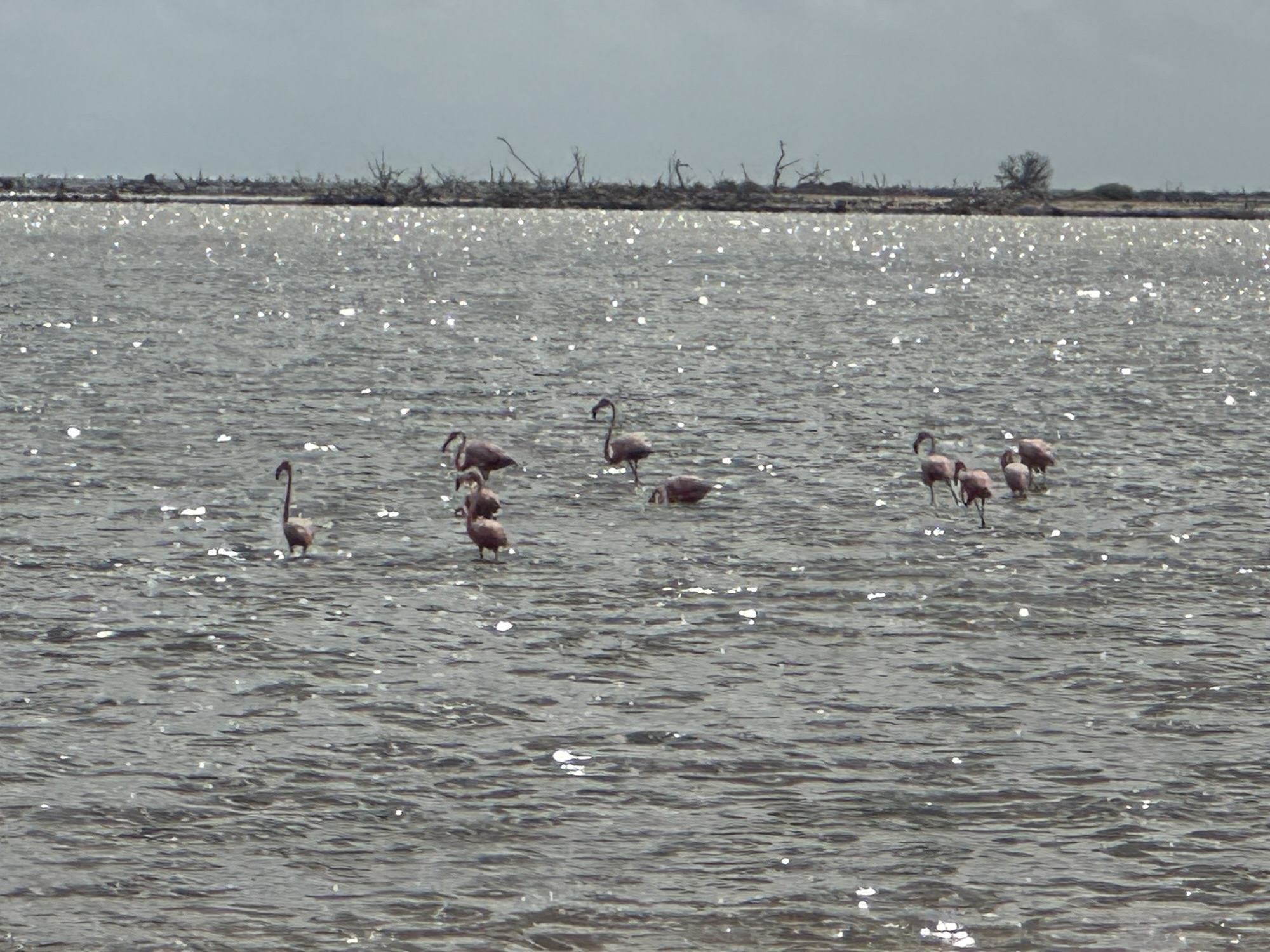
Friday morning found us excited to go see some flamingos, the lighthouse, and the Morton salt works. It also found us having caught up on our sleep – we slept for 10 hours! It’s nesting season for the flamingos and they make their nests very far in land – too far for our park ranger to take us – but we did get to see a good number of males in the salt ponds. Morton has 61 salt ponds connected by a series of channels and pumps. As the water evaporates the brine turns a pinkish color, and it can take years to be ready to harvest. We were fortunate that they had just started harvesting again this week as hurricane Oscar deposited so much water that harvesting had been at a standstill since October (it’s currently early May). 60% of the salt harvested on Great Inagua is used for road salt, then the rest is for medical reasons. No table salt here. Anywho, the male flamingos… Flamingos mate for life. After the egg is laid the males fly off to go back to the feeding ground, leaving the females on the nest. Our park ranger wasn’t sure if they go back and swap out incubation duties with the females or not. After our time seeing the flamingos and salt making process, we drove down to the lighthouse but unfortunately couldn’t go in as the steps are being renovated. We ate a delicious and overly filling lunch at a local restaurant, then walked through town and down to a local’s house to buy some freshly baked dinner rolls.


Saturday we had a midnight departure for the atoll. We put up the main and the Genoa and the wind speed and direction was so good that I actually got Chris up to help me out in a reef in the Genoa – surfing down waves at 8.5-9 knots was a wee bit nerve-wracking. Plus if we kept that speed we’d get to Hogsty reef (the atoll) before sunrise. Can’t have that – we need to be able to see when approaching and trying to anchor (you don’t want to drop your anchor on coral). I got to see a Starlink launch on my watch (it was so rolly and lumpy that my attempts at photography were laughable) and I got to see a shooting star burning green as it fell to earth.
The atoll was amazing! Maybe a little nerve wracking trying to find an anchoring spot as there have been so many shipwrecks here. But talk about glorious. Being in 6,000 feet of water and then POOF! suddenly you are in 28 feet of depth. We elected to anchor just off the northwest point, which was a little sandy spit with a small unlit tower to aid navigation. This is technically outside the atoll, but the wave motion seemed to be greatly reduced here compared to within the atoll, so thus our decision. The cacophony of the sooty terns on the island was honestly a delight. The smell when you near their nests, not so much! Yes it is nesting season for the Sooty Terns and this is a prime nesting location as there are no predators. How cool that we got to see Sooty Terns, as they are offshore birds that are rarely seen near land! We had wanted to explore the small tower but the terns were nesting all about the base and in a large patch to its side, so we got a view of the one side of the tower and left the birds to incubate on their nests in relative peace. There were a handful of Noddies, too. Not sure what type, but I think Brown Noddies, even though they appeared rather black. We did a quick snorkel by where we beached the dinghy but not much to see, other than a wrecked boat and a generator with a few blue fish. More interesting was all the conch fossils in the coral rocks lumped up near shore. And of course, on the inner side of the sandy spit, another wreck on the shore. The sea was rough inside the atoll and there was zero chance we were going to go snorkeling with the lumping, breaking waves and reports of bull sharks.


During a 3:30am sail change, something screamed in my ear, and then of course I screamed back. Apparently we picked up a second stowaway! This noddy scared the beejesus out of me and spent the rest of the night chilling on, and pooping all over, our solar panels.